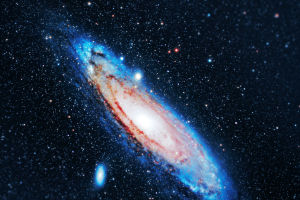
Imagine looking up at the night sky, surrounded by billions of stars, and realizing that Earth might not be the only home for life.
It's a thought that's both thrilling and mind-boggling. For centuries, the possibility of extraterrestrial life has been a topic of speculation, but recent scientific discoveries are bringing us closer to understanding if we're truly alone in the universe.
Breaking New Ground in the Search
The search for extraterrestrial life isn't just about looking for little green men; it's about looking for the right conditions. Scientists are exploring planets and moons in our own solar system and beyond to see if they have the building blocks necessary for life. So far, discoveries are suggesting that life might not be as rare as we once thought.
Exoplanets in the "Goldilocks Zone": Over the past two decades, astronomers have discovered thousands of exoplanets (planets outside our solar system), many of which are in what's known as the "habitable zone." This zone is the sweet spot where conditions are just right for liquid water to exist—a key ingredient for life as we know it. For instance, planets like Kepler-452b, often referred to as “Earth's cousin,” are found in these habitable zones, making them prime candidates for further study.
Mars: Once a Watery World: Mars has long been a focus of planetary research. Recent rover missions have uncovered compelling evidence that liquid water once flowed on its surface, including ancient riverbeds, minerals that form in the presence of water, and geological features resembling lake and stream environments. These findings suggest that billions of years ago Mars had a warmer, wetter climate that could have supported conditions suitable for life. The discovery of potential evidence for ancient microbial activity on Mars would dramatically change how we view the possibilities for life beyond Earth.
Life Beneath the Ice: Europa and Enceladus
While we've been busy searching for life on planets, some of the most promising leads might lie beneath the icy shells of moons like Europa (a moon of Jupiter) and Enceladus (a moon of Saturn). These moons have liquid oceans beneath their frozen exteriors, and scientists believe that these underground oceans could harbor life.
Europa’s Ocean Beneath the Ice: Jupiter’s moon Europa has long been a top target for exploration because its thick icy shell is believed to hide a vast subsurface ocean. Upcoming missions to study this moon aim to explore its icy crust and underlying water world in detail, searching for clues about whether conditions there could support life. Scientists think that the ocean beneath Europa’s ice may be in contact with the moon’s rocky interior, which could provide chemical energy and nutrients — essential ingredients for life as we know it — making Europa one of the most promising places in our solar system to investigate its habitability.
Enceladus's Water Plumes: Enceladus has taken a similar role in the search for alien life, particularly after the discovery of water plumes erupting from its surface. These plumes contain organic molecules—key ingredients for life. Analyzing these water jets could give scientists crucial clues about the potential for microbial life beneath Enceladus's icy crust.
Could We Detect Alien Life?
Finding alien life isn't just about discovering the right conditions; it's about being able to detect it. Advances in technology are pushing the boundaries of what we can discover and how we can detect life—both microbial and potentially more complex.
SETI and Radio Signals: The Search for Extraterrestrial Intelligence (SETI) has been scanning the skies for decades, listening for signals from intelligent alien civilizations. While we haven't found any definitive signals, advancements in radio telescope technology are making it easier to detect unusual signals from distant stars and galaxies.
Chemical Signatures in Exoplanet Atmospheres: The study of exoplanet atmospheres is another exciting frontier. Instruments like the James Webb Space Telescope (launched in 2021) are capable of detecting the chemical makeup of distant planet atmospheres. Scientists are on the lookout for gases like oxygen, methane, and carbon dioxide, which could indicate biological activity.
The Implications of Discovery
Finding extraterrestrial life, even in microbial form, would be one of the most groundbreaking discoveries in human history. But what would it mean for us? How would our view of the universe change if we were to find evidence that life exists—or has existed—beyond Earth?
A New Perspective on Life: The discovery of alien life would expand our understanding of biology, evolution, and the conditions necessary for life. It would challenge our place in the universe, prompting deep philosophical questions about the uniqueness of life on Earth. Are we part of a vast cosmic community, or is our planet truly one-of-a-kind?
Exploring Ethical Questions: The discovery of extraterrestrial life also raises important ethical considerations. What responsibilities would we have toward these life forms? Should we attempt to communicate with them, or might that pose risks? These questions would spark debates in both the scientific community and society at large.
Looking Ahead: The Future of Space Exploration
While there's still much to learn, the hunt for alien life is only just beginning. With missions to Mars, the exploration of icy moons, and the development of more powerful telescopes, we're gaining the tools needed to answer one of humanity's most profound questions: Are we alone in the universe?
The search for extraterrestrial life is more than just a scientific endeavor—it's a quest that could redefine our understanding of life itself. Whether we find life on another planet or not, the search continues to inspire us to look beyond our own world and into the vastness of space. As technology advances, we might soon have an answer. And when we do, it will change everything.