People are often surprised by the sugar in fruit — either assuming it's negligible because fruit is "natural," or avoiding entire categories because they've heard fruit sugar is bad.
Neither framing is accurate. Fruit contains real sugar that the body processes and responds to, but it also contains fiber, water, and other compounds that fundamentally change how that sugar behaves.
The two numbers that actually matter are sugar content per 100 grams and glycemic index — and they don't always tell the same story.
What the Numbers Mean
Fruit sugar comes primarily as fructose and glucose, present separately rather than combined as sucrose. Fructose is metabolized primarily by the liver; glucose enters the bloodstream directly. When fiber is present — which it is in whole fruit — it slows the absorption of both, reducing the rate at which blood sugar rises. This is why the glycemic index (GI) of whole fruit is typically much lower than the same amount of sugar in a processed food or juice form. A GI below 55 is considered low, 56 to 69 medium, and 70 or above high.
The glycemic load (GL) is a more practical metric than GI alone. GL accounts for both the GI and the actual amount of carbohydrate in a realistic serving. A food can have a high GI but low GL if you eat a small portion — which is why a half grapefruit, despite some tartness suggesting high acidity, has a glycemic load of only about 4.4.
Lower-Sugar Fruits
Avocado is the lowest-sugar common fruit, with approximately 0.6 grams per 100 grams. This makes sense given that avocados are high in lipids rather than sugar, which is what gives them their creamy texture. Most people don't think of avocado as a fruit at all, which is technically incorrect.
Strawberries contain around 4.9 grams of sugar per 100 grams with a GI of approximately 40 — comfortably in the low range. The 3.3 grams of fiber per cup slows sugar absorption meaningfully. Raspberries are similarly low, at about 4.4 grams of sugar per 100 grams, and are particularly high in fiber relative to their sugar content. Kiwi sits at around 9 grams per 100 grams but has a GI of approximately 47, keeping it firmly in the low-GI category. Peaches are in a similar range at about 8 to 9 grams per 100 grams with a GI around 42.
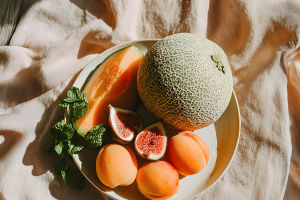
Cantaloupe contains roughly 7.9 grams of sugar per 100 grams and benefits from its very high water content — the actual sugar per serving is modest because so much of the weight is water. Oranges deliver around 9 grams per 100 grams with a low GI of approximately 43, and the fiber in the whole fruit keeps the glycemic load low.
Medium and Higher-Sugar Fruits
Pineapple runs about 10 grams of sugar per 100 grams with a moderate GI around 59, placing it in the medium-GI category. Its fiber content is reasonable but not as high as berries, so it digests somewhat faster.
Bananas vary substantially by ripeness. An unripe green banana contains primarily resistant starch, which isn't digested as sugar at all, with a GI around 30 to 40. A fully ripe yellow banana has converted that starch to sugar, reaching approximately 15 to 17 grams of sugar per 100 grams and a GI of 50 to 60. Eating a slightly underripe banana is meaningfully different metabolically than eating a very ripe one.
Mangoes contain around 14 grams of sugar per 100 grams with a GI of approximately 51 — lower than the sugar content might suggest, because the fiber slows absorption. Grapes reach about 16 grams per 100 grams with a higher GI around 59, and because they're easy to eat in large quantities, the glycemic load per actual serving can add up quickly.
The Watermelon Paradox
Watermelon presents an interesting case that The Takeout's analysis highlights clearly. Its raw sugar content per 100 grams is only about 6.2 grams — lower than oranges. But its GI is between 72 and 76, making it one of the highest-GI common fruits. This is because watermelon has very low fiber relative to its water content, so the sugars present absorb quickly despite the low total quantity. It has a low glycemic load per standard serving because a serving is mostly water by weight, but eating three or four cups changes that calculation substantially.
Sugar content alone doesn't determine whether a fruit is a good choice for blood sugar management. The full picture requires knowing the fiber content, the GI, and how much you're actually eating. Berries, kiwi, peaches, and citrus fruits sit in the most favorable zone — meaningful nutrition with relatively low and slow-absorbing sugar. Grapes and very ripe bananas eaten in large quantities at once have the most potential to spike blood sugar. Most whole fruits, eaten in reasonable portions alongside other foods, behave very differently from equivalent amounts of refined sugar — and the research consistently shows that whole fruit consumption, even in people managing blood sugar, is associated with better rather than worse health outcomes.