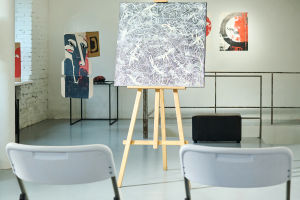
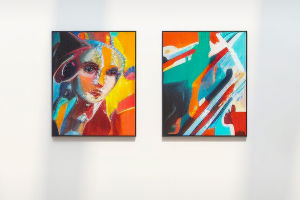
You scroll past a video: a young artist flings neon paint across a giant canvas in slow motion. The music swells, colors burst, and in 30 seconds, a "masterpiece" is born. People flood the comments—"Genius!" "You're the next Picasso!" "I'd buy this right now!"
But here's a question that lingers long after the likes roll in: if a painter becomes famous through TikTok, does that make them a real artist? That's not just a question of taste—it's about how we define art in a world ruled by algorithms.
Fame used to follow the work. Now the work follows the fame.
Before short-form video took over, artists typically followed a slower path: years of practice, exhibitions, rejection, growth, maybe eventually recognition. That process still exists—but it's no longer the only way.
Now, someone with zero gallery experience can post a time-lapse of a painting and wake up with 200,000 followers and an online shop that sells out every drop. The art world used to be gatekept. TikTok broke down the door.
And that's a double-edged brush.
On one side, platforms like TikTok democratize visibility. You don't need connections or a fancy art degree. You just need something visually sticky—something that hooks the eye in the first three seconds. Abstract splashes? Giant murals? Fast-motion transformations? Perfect.
But the question is: what's being rewarded here—the art, or the spectacle?
When the algorithm becomes the curator
Art on TikTok is often optimized for performance. Creators post what's likely to get attention, not necessarily what's most meaningful. That changes the creative process entirely.
1. The format favors speed and scale. Viewers want satisfying results in under a minute. Slow, subtle work rarely survives the scroll.
2. Visual shock wins. Flashy colors, oversized canvases, and fast movements outperform quiet complexity.
3. Engagement dictates direction. A video goes viral? The artist makes 10 more like it. Style becomes formula. And sometimes, meaning gets left behind.
This doesn't mean these creators aren't talented. Many are. But the platform shapes the product. When every piece is designed to "go viral," we have to ask: is this still art—or is it content in an art costume?
The line between art and performance
Let's be honest: part of what we love about TikTok art isn't the final piece—it's watching it happen. The process is performative. There's satisfaction in seeing paint poured, lines drawn, textures created. The end result often feels secondary.
This blurs the line between artist and entertainer. Which isn't a bad thing—unless we confuse performance with depth.
Imagine a painter who livestreams every piece, tweaks their work based on comments, and builds a brand around trendy visuals. Are they less "real" than someone painting alone in a quiet studio?
Not necessarily. But they're playing a different game—with different rules.
Is popularity the new measure of value?
Here's where the tension sharpens: traditional artists can spend years refining their voice, experimenting, growing slowly. Meanwhile, someone goes viral for drip painting with a broomstick—and sells prints faster than gallery artists move originals.
That stings. And it's not just jealousy. It raises a serious question: if art is about expression and exploration, but success now hinges on virality, how do artists stay true to the work?
Worse, how do audiences learn to distinguish between genuine innovation and algorithm-friendly decoration?
How to engage with TikTok art more meaningfully
The good news? You don't have to pick sides. TikTok artists can be legitimate artists. But it takes a little more than a "like" to truly connect with their work. Try this:
1. Look beyond the clip. If you love what you see, explore the artist's other work. Do they have a distinct style or just a viral formula?
2. Read their captions or statements. Some artists explain their themes, process, or intentions in ways the video can't capture.
3. Follow for growth, not just spectacle. Watch how an artist evolves. Are they experimenting or repeating what sells?
4. Support intentionally. Buying prints or originals? Great. But choose art that speaks to you—not just what went viral last week.
So… what makes someone a "real artist” now?
Maybe it's not about gallery representation or follower counts. Maybe it's not about whether their canvas hangs in a museum or sells on Etsy.
Maybe it's this: does the work say something? Does it reflect effort, voice, curiosity, or care?
Because being an artist has never just meant making nice things. It means offering a way of seeing, a perspective, a message—even if it's wrapped in glitter and shot in 4K.
There are viral painters out there who meet that standard—and others who just know how to game the system. Our job, as viewers and supporters, is to tell the difference.
And maybe sometimes, to stop mid-scroll and ask: Is this just cool to watch, or does it actually move me?
That one question can change how you experience everything from swipeable sketches to slow, soulful masterpieces.
Next time you find yourself mesmerized by a hyper-speed paint video, pause. Click through. See if there's more beneath the surface. Not every viral artist is visionary—but some of them are. And you just might find someone whose work speaks to something deeper than the algorithm ever could.